
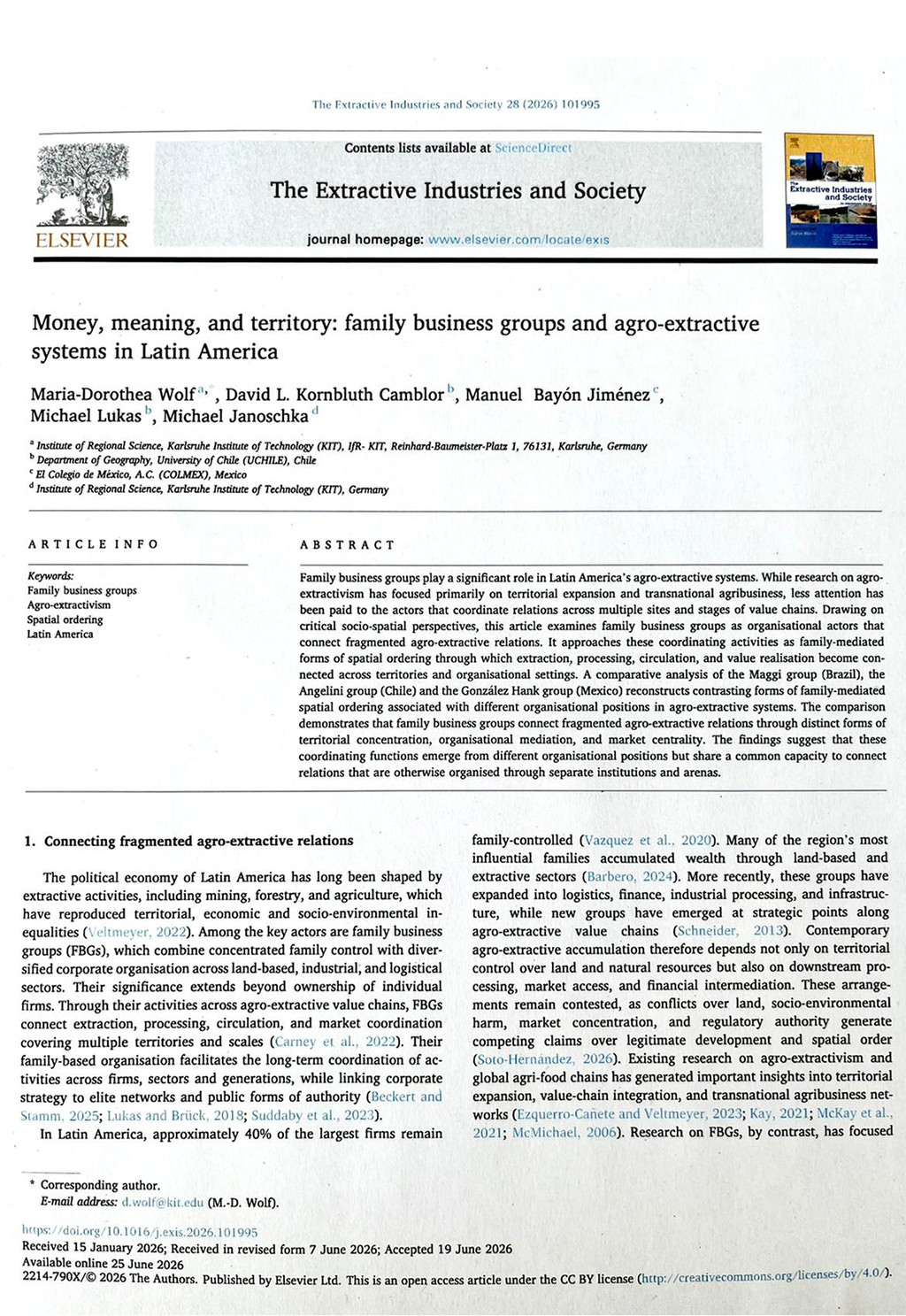
Wolf, M.-D.; Kornbluth Camblor, D.; Bayón Jiménez, M.; Lukas, M. and Janoschka, M. (Dec. 2026)
Family business groups play a significant role in Latin America’s agro-extractive systems. Drawing on critical socio-spatial perspectives, this article examines family business groups as organisational actors that connect fragmented agro-extractive relations. A comparative analysis of the Maggi group (Brazil), the Angelini group (Chile) and the González Hank group (Mexico) reconstructs contrasting forms of family-mediated spatial ordering associated with different organisational positions in agro-extractive systems. The comparison demonstrates that family business groups connect fragmented agro-extractive relations through distinct forms of territorial concentration, organisational mediation, and market centrality. The findings suggest that these coordinating functions emerge from different organisational positions but share a common capacity to connect relations that are otherwise organised through separate institutions and arenas.
In: Extractive Industries and Society, v 28, 2026. DOI: https://doi.org/10.1016/j.exis.2026.101995
Link to Publication
De O. Evangelista, M. and Sauer, S. (2025).
This research examines the contradictions and socio-environmental impacts of Matopiba, a region of 337 municipalities in the Cerrado across Maranhão, Tocantins, Piauí, and Bahia, defined in 2015 as the “new and last” agricultural frontier. Linking its creation to Brazil’s land history, it analyzes how wealth appropriation, framed as development, sustains and expands territorial contradictions. While recent growth has driven record agricultural and mineral exports, it also intensifies deforestation and deepens inequalities and land conflicts, exposing the contradictions of agro-export expansion on the Brazilian frontier.
In: Retratos de Assentamentos. vol. 28, n. 02, 2025, 219-237. DOI: https://doi.org/10.25059/2527-2594/retratosdeassentamentos/2025.v28i2.640
Link to Publication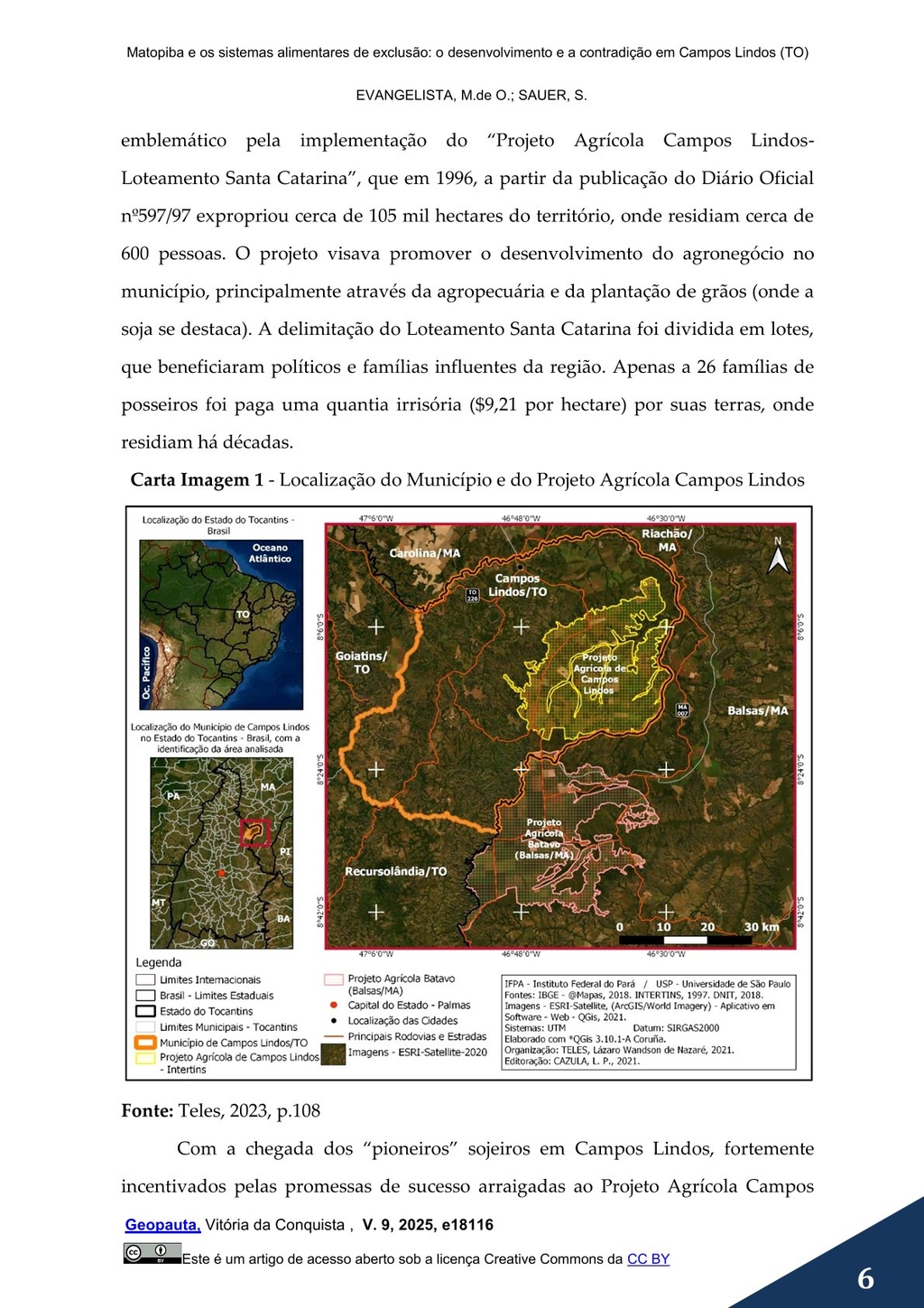
De O. Evangelista, M. and Sauer, S. (2025).
The idea that food systems depend mainly on production volume overlooks the roles of sustainability, culture, and food quality in their reproduction. In Campos Lindos, a key case in the Matopiba agricultural frontier, agribusiness-driven growth produces high output yet coexists with precarious social conditions and food insecurity, revealing these contradictions. Based on interviews with nine rural producers, this study examines their perceptions, the food context they operate in, and how agribusiness dynamics drive frontier expansion while deepening inequality and food insecurity.
In: Geopauta, Vol. 9, 2025, e18116. ISSN: 2594-5033 - http://periodicos2.uesb.br/index.php/geo; https://doi.org/10.22481/rg.v9.18116.pt.
Link to Publication
Reis, N. and Vargas Magaña, G. (2025).
Mexico’s state-owned Banco del Bienestar is central to the government’s project of promoting an “alternative to neoliberalism” and a “moral economy.” This chapter argues that, despite supporting the poor through social benefits and microcredit—especially during the Covid-19 crisis—the bank primarily advances a financial inclusion agenda shaped by alliances among global financial institutions, Mexican elites, the military, and parts of the left. This agenda reinforces a “moral economy” that deepens the poor’s dependence on the state and integrates them into exploitative relations with financial and corporate actors.
In: Review of Political Economy, 37(3), 937–964. https://doi.org/10.1080/09538259.2024.2319198
Link to Publication
Mejía-Forero, K.; Coma, M. C.; Bayón-Jimenez, M. and Armas-Díaz, A. (2025).
The paper examines processes of accumulation, neoliberalization, and the exploitation of human and non-human nature, as well as responses to these dynamics in Latin America and Southern Europe. Based on these territorial contexts, it proposes a theoretical framework from political ecology and critical geography: territorial accumulation. This approach is presented as a tool for understanding inequalities in a context of multiple crises and as having emancipatory potential for dispossessed, disadvantaged, and marginalized groups.
In: Scripta Nova: revista electrónica de geografía y ciencias sociales, 29(2), 15-38.
Link to Publication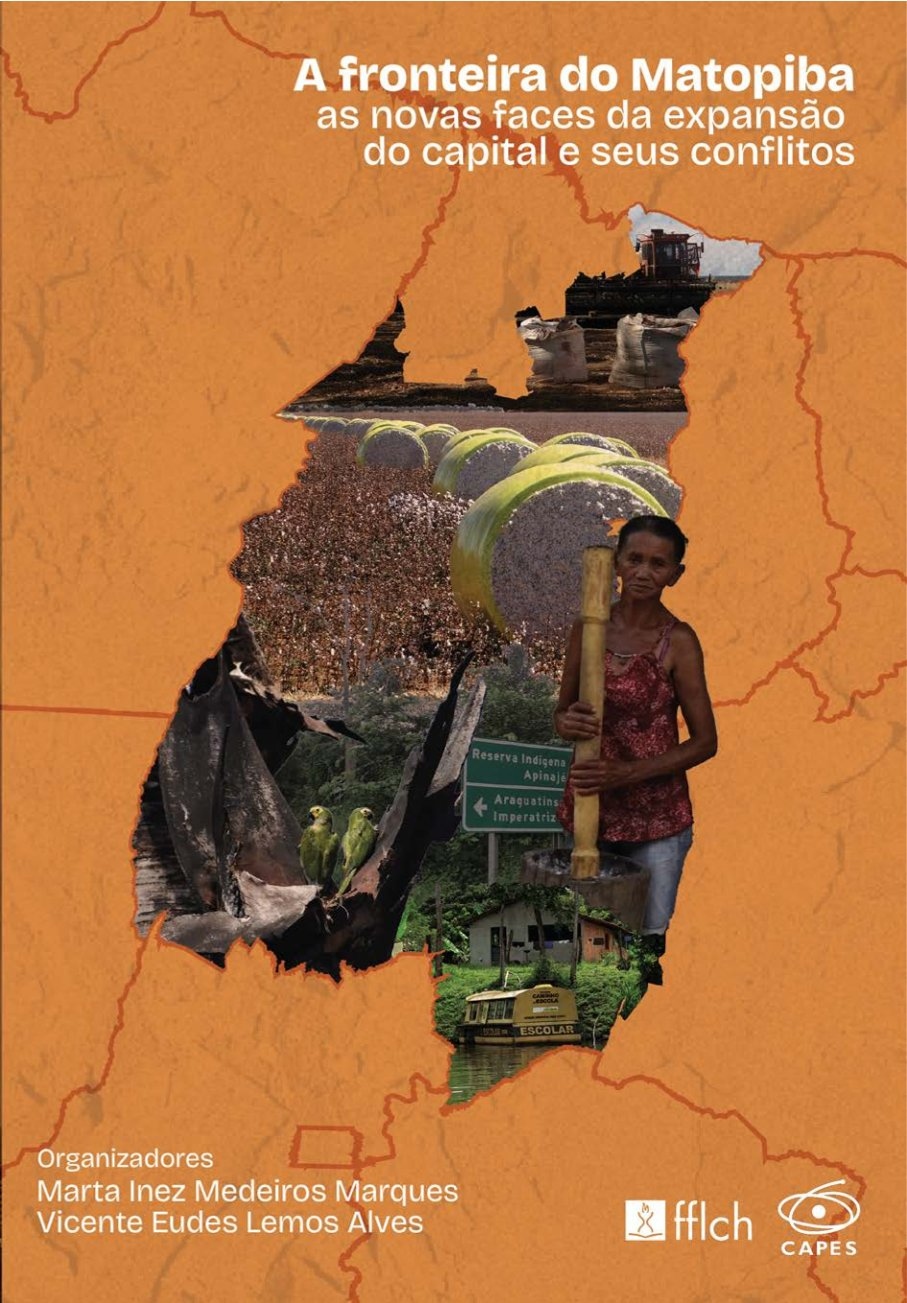
Leite, A. Z.; Sátiro, G. S. and Sauer, S. (2024).
The political framing of MATOPIBA as an uninhabited and underused frontier hides key social and economic issues, including that expansion drives deforestation and that monoculture relies on land grabbing and illegal appropriation of public lands. The text examines historical processes of accumulation and dispossession and their socio-environmental impacts, focusing on conflicts over land, water, slave labor, and violence in Brazil’s Cerrado, especially MATOPIBA. Based on literature and data analysis, it relates land distribution and conflicts to the expansion of soy production. As the region becomes a “sacrifice zone,” it highlights the need to rethink development models and implement policies to protect traditional populations and prevent land and resource appropriation.
In: MARQUES, Marta Inez Medeiros; ALVES, Vicente Eudes Lemos (eds.). The Matopiba Frontier: New Faces of Capital Expansion and Its Conflicts. São Paulo: FFLCH, 2024. p. 425–453. ISBN: 978-85-7506-512-9. DOI: https://doi.org/10.11606/9788575065129
Link to Publication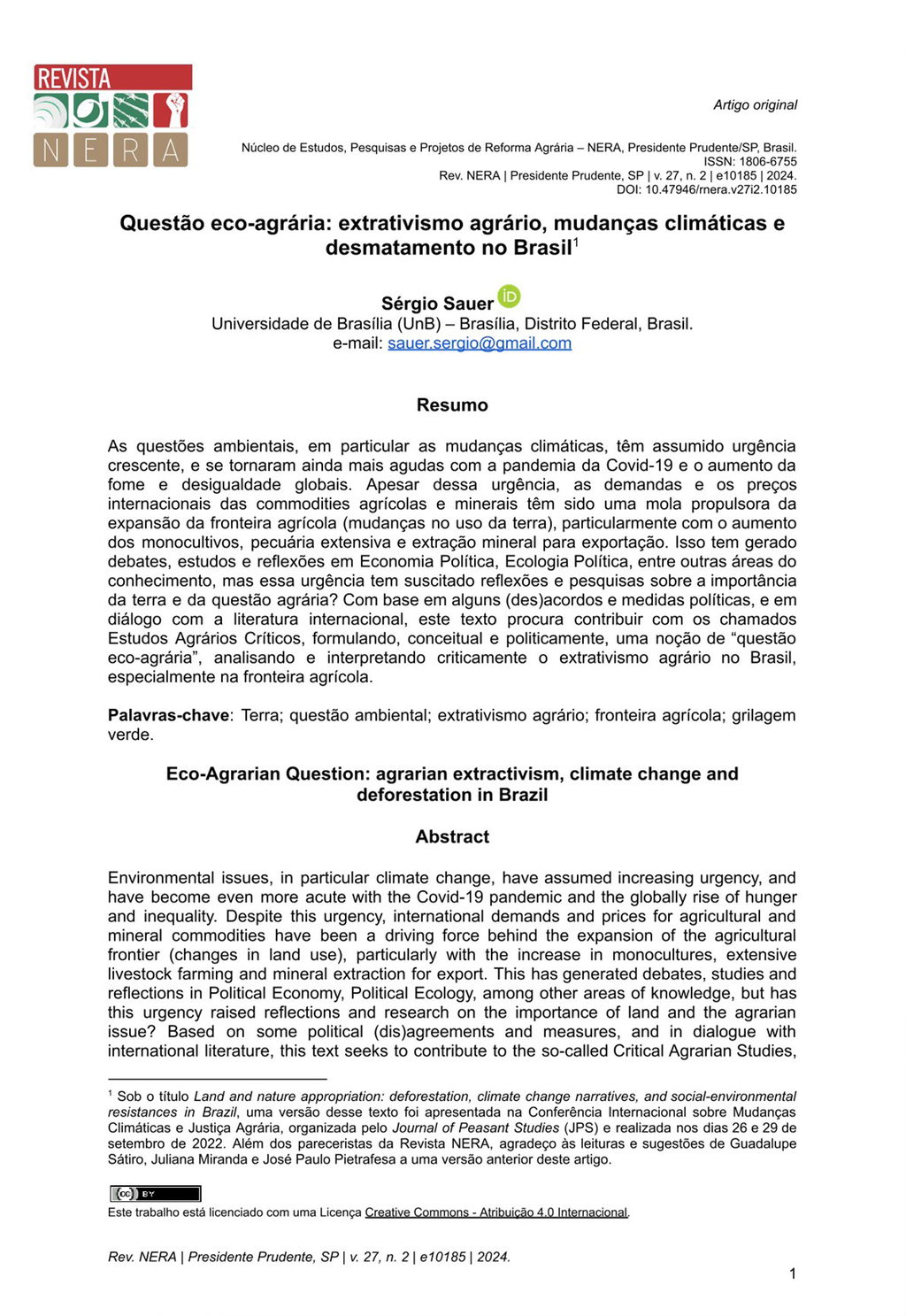
Sauer, S. (2024).
Environmental issues, especially climate change, have become more urgent, intensified by the Covid-19 pandemic and rising hunger and inequality. Yet demand for agricultural and mineral commodities continues to drive frontier expansion, including monocultures, livestock, and extraction for export. This text engages debates in Political Economy and Political Ecology, asking whether this urgency has renewed attention to land and agrarian questions. It contributes to Critical Agrarian Studies by proposing the concept of an eco-agrarian issue and critically analyzing agrarian extractivism in Brazil’s agricultural frontier.
In: Revista NERA (UNESP), v. 27, n. 02, p. 1-30, 2024. DOI: https://doi.org/10.47946/rnera.v27i2.10185
Link to Publication